
Parable 34 — Roland's Metamorphosis: A Parable About Freedom
December 30, 2025
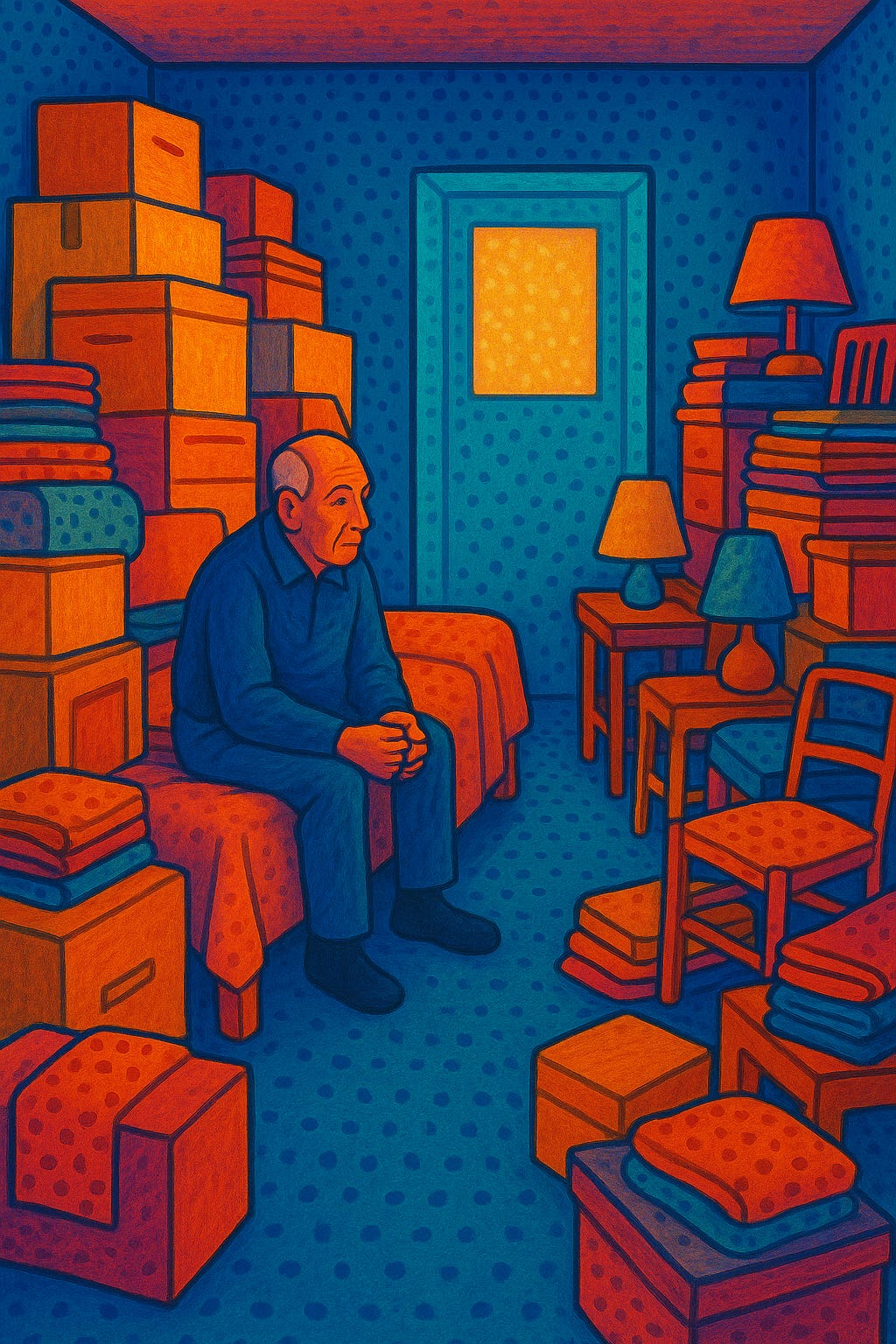
Escaping
In his final years, Roland found himself grateful for the prospect of death.
Death started to seem like a relief, a way to escape the endless cycles of longing, reaching, taking, and then holding onto things. The constant push and pull between day and night had worn him out for as long as he could remember, and through it all, he had followed the same repetitive pattern of desire, pursuit, acquisition, possession, and then another reach for more.
He spent his years driven by a hunger he never fully understood. Now, as his body grew weaker and his rooms filled with possessions he no longer touched, he came to believe that the only real way to break the cycle, his last true act of freedom, was to die.
He told himself that his leaving would be a gift. The space his body occupied would be freed. The food he consumed would remain for someone else. Even the air he breathed would return to others. His modest apartment, too, would one day belong to another. In escape, he imagined, he could finally be generous.
Yet one troubling thought would not leave him.
In the long afternoons of half-sleep, Roland’s thoughts wandered back to his earlier years, those seasons of life when his yearning for possessions had been at its strongest. He remembered vividly the intensity of his desires, a time when almost anything material could capture his longing: money, furniture, rich fabrics, tools, cars, and even entire collections of artifacts. Many of these items, their specific purposes now lost to him, had been gathered in moments of restless want. He had not bought these things for their usefulness, but rather for the fleeting exhilaration of simply acquiring them. Satisfaction was always short-lived, but the urge to possess had remained constant and powerful throughout the years.
Now those once-coveted objects sat silently around him.
He had once justified his appetite by telling himself that his belongings would become treasures for others. But recently, he had learned otherwise. His kindhearted niece came with a notebook and carefully listed what might be sold. People came and went, glanced, and turned away. It was not that the objects were broken. They simply were no longer wanted. Tastes had changed.
This discovery wounded him more deeply than he expected. It was not only that his things had lost their value, but that his longing itself had become invisible to the world.
So, when the final night arrived, Roland welcomed it with anticipation. His breath grew light, the room dimmed, and he imagined himself stepping off the great wheel of desire at last, leaving behind its noise and endless circling. In that thought, he found peace.
Rebirth
Then Roland fell into darkness.
Soon, he awoke suspended in warmth, free of pain and memory, aware only of being held. Time moved in a strange, folded way. Something inside him worked without words. He did not dream as a man dreams, but as forms dream when life prepares itself for what comes next.
After what felt like both an instant and an age, the world opened again.
Roland emerged as a butterfly.
At first, he felt only triumph. The heavy body of his old life was gone. The closed rooms had vanished. The dust of years no longer clung to him. He floated as if released from gravity itself.
But beneath that lightness, a quiet unease stirred.
Without knowing why, he began to search not only for nectar, but for colors, textures, and shapes that tugged at something inside him. He hovered near windows and market stalls. He circled piles of cloth and drifted over objects warmed by sunlight. Again and again, he returned to the same silent invitations.
He could not name what he sought. He had no memories of rooms, no awareness of his age, no thoughts of having once been a man. And yet the wanting remained, strong and familiar.

Slowly, Roland came to understand that although his form had changed, a deeper movement within him had not. His wings carried him freely, yet they restlessly followed old grooves of attraction. The same inward pull drew him toward the world of things, even though he no longer had hands to hold them.
Still, he found comfort in the short life of a butterfly. This too would soon end. And perhaps, in the next beginning, he would finally be free of the old hunger. So, he flew from flower to flower, carrying with him a slender thread of hope.
Soon, darkness returned. And then, light again.
Becoming an Ephemeral Presence
This time, Roland did not awaken in a body. He awoke as an ephemeral presence, a light and delicate being, beautiful, almost too perfect to be real. He stood within a vast openness that felt neither inside nor outside himself. He had no weight, and yet he was unmistakably present. He was not drifting. He was awake and felt held.
Now memories returned, not only of being a man and a butterfly, but also the dim knowing of having been a slow worm, an insatiable eater of leaves. He also remembered his own countless human lives.
The many memories seemed like a single sentence written in different scripts. Each escape attempt brought with it a variation of the same unrelenting hunger.
He felt at once the unending appetite of the caterpillar, the drifting restlessness of the butterfly, the grasping years of the man, and now this weightless vision that neither asked nor fled.
At last, Roland understood.
The wheel of desire had never been his prison.
The mistake had been believing that freedom meant stepping off it.
He saw then how often he had tried to outrun his own momentum rather than learn to guide it. He had mistaken endings for liberation, forgetting for wisdom, and the turning itself for trouble, when the actual work had always been learning how to turn.
As a presence, he no longer wished to escape. For the first time, he did not dream of another death. Instead, he felt drawn to quieter labor: the slow, unseen work of inclination, of tuning desire, of bending memory, of shaping the next turning toward care.
In that recognition, something profound in his wanting softened, not erased, not denied, but gently reoriented.

The Modest Work of a Hinge-Keeper
It is said that ephemeral presences do not interfere with the turning of the world. Their work is far more modest. In the wheel of desire, they are the hinge-keepers.
They whisper into the currents of habit.
They bend longing by the tiniest fraction of a degree.
They warm the invisible hinges where one direction becomes another.
And somewhere in the world, a caterpillar pauses on a leaf.
A butterfly lingers over a color it once passed by.
A human hand hesitates before taking what it does not need.
As a hinge-keeper, Roland’s final and quiet realization was this: Freedom is not given by dying. Freedom is learned by living with one’s eyes open.
Epilogue: Lessons Learned
We spend much of our lives believing that freedom waits somewhere beyond who we are, beyond our bodies, our habits, our histories. But freedom does not live on the far side of escape. It lives in the quiet work of orienting ourselves differently, moment by moment, within the life we already inhabit.
Questions for Reflection
What am I still trying to escape, rather than learning to orient myself differently within it?
Which old habit follows me, even when my circumstances change?
What would it mean, today, to bend my desire just a little toward care?
"Grandma Loves AI", A Short Story Collection, ©Iris Stammberger